By Scott Green, EVP — Enova Illumination
Looking Beyond the Loupe Basics
When choosing dental loupes, it’s important to look beyond magnification alone. I really believe the dental industry spends way too much time talking about magnification (power), ocular styles, and frame designs—and not nearly enough time talking about the entire visualization system.
The other thing we can’t forget is that every clinician/student is different. Some are tall, some are short. Some wear strong prescriptions; others have perfect vision. Some have incredible hand-eye coordination, while others… well, let’s just say they probably shouldn’t be playing darts.
Of course, comfort varies from person to person, which is why proper frame fit and weight distribution are often more important than the overall weight of the loupes themselves. At the same time, higher-magnification loupes continue to grow in popularity as loupes have become the standard of care and clinicians/students recognize the value of seeing finer anatomical details more clearly. The challenge is balancing higher magnification with comfort, ergonomics, and long-term wearability.
Why Choosing Dental Loupes Should Be Individualized
That’s why I believe every clinician and every student should be evaluated as an individual before anyone recommends a loupe. The goal isn’t simply to choose a magnification level (power)—it’s to build the right visualization system for that person’s anatomy, clinical needs, and career. When someone asks me, “Which loupe should I buy?” my answer usually surprises them. I tell them not to start by asking, “How much magnification do I need?” or “Should I get Galilean, Prismatic (Keplerian), or an ergonomic deflection design?” Instead, start with a much bigger question: “What optical system is going to help you learn, train, and work comfortably, safely, and consistently—not only to graduate and pass your boards, but also to enjoy a long, healthy career over the next 30 or 40 years?”
Magnification level (power) is just one piece of the puzzle. The quality of the optics, your lighting, working distance, field of view, depth of field, ergonomics, weight, and even how naturally you can communicate with your patient all play a huge role. When you look at the whole system instead of just the magnification number, you’re much more likely to end up with the right solution.
The Development of Ergonomic and Deflection Loupes
One of the biggest advances in dentistry over the past twenty years has been the development of ergonomic or deflection loupes. Much of that evolution started with HOYA in Japan, whose surgical deflection optics eventually became part of the HOYA-PENTAX platform. Instead of requiring the operator to bend their head toward the patient, prism optics redirect the image downward so the clinician can maintain a much more upright posture.
That was a major step forward for dentistry because neck and back problems have become almost expected during a long career.
The Limitations of Ergonomic Loupes
But like everything else, ergonomic loupes aren’t perfect.
One thing that doesn’t get discussed very often is that many ergonomic loupe designs place a fairly large prism housing directly in front of your eyes. The result is that looking straight ahead can sometimes feel more restricted than it does with a traditional loupe. You notice this when you’re trying to make eye contact with a patient, talk to your assistant, glance at a radiograph, or review a digital chart. Those little transitions happen hundreds of times every day.
Some manufacturers recommend simply looking underneath the optics. The problem is that this usually requires extending your neck backward. From an ergonomic standpoint, replacing neck flexion with repeated neck extension isn’t really solving the problem.
Maintaining Direct Vision With Enova Ergo Loupes
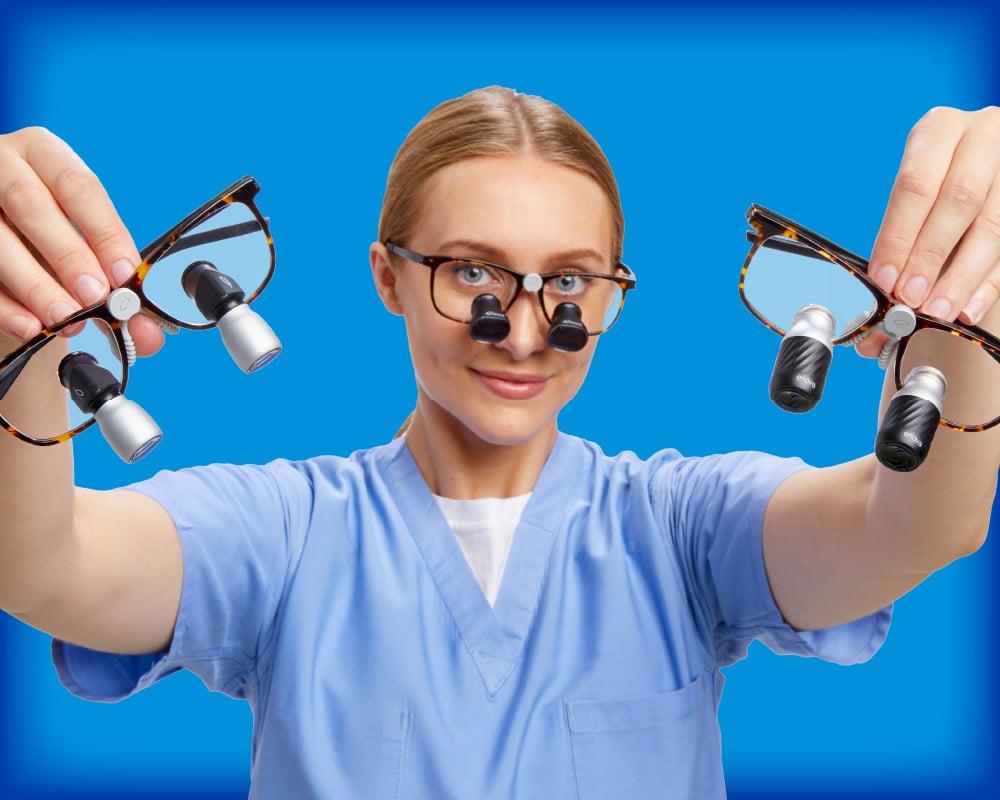
One thing I really like about our Enova Ergo design is that it was intentionally engineered so clinicians can see above and around the optics more easily. By positioning the telescopes slightly lower in the carrier lens with a subtle declination angle, we create a larger area of unobstructed direct vision above the oculars. It may sound like a small design change, but in everyday practice it makes a big difference when talking with patients, communicating with assistants, or glancing at radiographs and monitors.
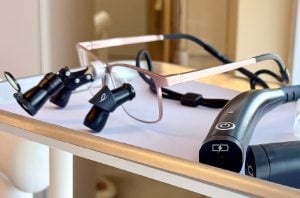
We took that concept even further with the Micro Ergo Elite loupe design. This optical system was designed to minimize weight without sacrificing performance. Pair it with the Axis Elite LED loupe light, carry the battery comfortably around your neck/shoulders, and you have one of the lightest and most comfortable loupe/light combinations in the world.
How Patient Positioning Affects Ergonomic Loupes
Another point that often gets overlooked is patient positioning.
Most ergonomic loupes are designed around an ideal situation where the patient is lying completely flat. Under those conditions, they perform extremely well.
The challenge comes when the patient can’t tolerate that position.
Think about a patient in the second or third trimester of pregnancy, children, someone with vertigo, an elderly patient with severe kyphosis or arthritis, or someone with heart failure or respiratory disease who simply cannot lie flat comfortably. As the chair becomes more upright, the geometry between the operator and the optics changes, and many ergonomic systems become more difficult to use.
That doesn’t make ergonomic loupes bad, it simply means no single loupe is ideal for every clinical situation. Patient positioning is another important factor to consider when choosing dental loupes.
Traditional vs. Ergonomic Dental Loupes
Until operating microscopes become common in every dental office, I honestly think dentists and hygienists benefit from owning both a traditional loupe and an ergonomic loupe. Traditional loupes remain incredibly versatile and adapt well to almost any patient position. Ergonomic loupes provide tremendous advantages when conditions are ideal and you’re performing long, precision-based procedures.
I don’t think these systems compete with one another—I think they complement one another.
How Much Magnification Should Dental Students Use?
This also ties into something I’ve been discussing with several dental schools.
A number of faculty members have told me they’re becoming concerned that students are starting with too much magnification too early. Many students are purchasing 4.5x or even 5.5x loupes before they’ve mastered basic instrumentation, indirect vision, mirror skills, or proper hand control.
Why 2.5x Conventional Loupes Are a Strong Starting Point
Personally, I still think 2.5x conventional loupes are the best place to start.
A lower magnification gives students a wider field of view, more depth of field, and better awareness of the entire operating field. They learn hand-eye coordination first instead of trying to chase tiny details. Once those skills become second nature, moving into 3.5x ergonomic loupes during simulation or chair side patient care becomes a much smoother transition.
By the time they’re performing advanced restorative procedures or endodontics, moving into 4.5x or 5.5x becomes much more natural.
Understanding Depth of Field and Field of View
One thing students should also understand is that depth of field isn’t determined only by the loupe alone. It’s also influenced by the person wearing it. Younger clinicians usually have a greater ability to keep objects in focus as they move slightly toward or away from the patient because the eye still has good natural accommodation. As we get older, that ability gradually decreases, so the same loupe can feel less forgiving even though the optics haven’t changed. That’s one reason two clinicians wearing identical loupes may describe very different experiences.
As with any optical system, increasing magnification gives you greater detail while reducing field of view and depth of field. Rather than publishing one fixed field-of-view or depth-of-field specification, Enova custom builds each loupe to the clinician’s working distance, interpupillary distance, facial anatomy, and prescription, which is really the right way to approach optical fitting because no two clinicians are exactly alike.
Why Coaxial Illumination Matters
Lighting is equally important. As magnification increases, good coaxial illumination becomes essential. A high-quality LED light with a uniform beam and natural color temperature often makes as much difference as the optics themselves. The Axis Elite LED Light System is Enova Illumination’s flagship loupe light and was designed around three primary goals: maximum illumination, minimal head weight, and improved ergonomics. Unlike many traditional loupe lights that place more weight on the front of the loupes.
Ergonomic Loupes as a Bridge to Microscope Dentistry
Ergonomic loupes and coaxial lights should be viewed as a bridge to microscope dentistry rather than the final destination.
The operating microscope is still the gold standard for visualization and ergonomics. It gives you exceptional optics at low levels (2x) to high (20x) magnification power, outstanding illumination, and a truly upright working posture. Just as importantly, it allows you to instantly transition from magnified treatment to unrestricted direct vision whenever you need to communicate with the patient or your team. I think we’ll continue to see microscope use expand well beyond endodontics into restorative dentistry, prosthodontics, periodontics, and even dental hygiene.
Finding the Right Dental Visualization System
At the end of the day, when choosing dental loupes, I don’t think the goal is to find the “best” loupe. The goal is to find the right visualization system for the procedure(s) you’re performing, the patient sitting in your chair, and your level of clinical experience.
If we teach students that progression—and help them understand that visualization is more than magnification—I think we’ll produce clinicians who are not only more comfortable throughout their careers but also safer and more confident treating patients.
Frequently Asked Questions About Choosing Dental Loupes
What should I consider when choosing dental loupes?
Magnification is only one part of the decision. The quality of the optics, lighting, working distance, field of view, depth of field, ergonomics, weight, prescription, facial anatomy, and ability to communicate naturally with patients should all be considered when building the right visualization system.
What magnification should dental students start with?
I believe 2.5x conventional loupes are the best place to start. Lower magnification provides a wider field of view, greater depth of field, and better awareness of the operating field while students develop instrumentation, indirect vision, mirror skills, and hand-eye coordination.
Are ergonomic loupes better than traditional loupes?
Neither system is ideal for every clinical situation. Traditional loupes are versatile and adapt well to different patient positions, while ergonomic loupes offer significant postural advantages during long, precision-based procedures. Rather than competing, the two systems can complement one another.
Why is lighting important when using dental loupes?
As magnification increases, good coaxial illumination becomes increasingly important. A high-quality LED loupe light with a uniform beam and natural color temperature can improve visualization while minimizing shadows within the operating field.